
Imagine this: a sun-drenched piazza in Sicily, a menu filled with unfamiliar names, and the quiet worry that you might choose a tourist-pleaser over a true taste of the island. It’s a common feeling, a desire to connect authentically with a place through its most cherished traditions. The true magic of sicilian cuisine is that it’s more than just a collection of recipes; it is a vibrant narrative written in flavor, a story of sun, sea, and centuries of cultural fusion.
This guide is your personal invitation to read that story. Consider it your trusted companion, designed to navigate you away from the inauthentic and toward the unforgettable. We will journey through the rich history that shapes each plate, from Arab spices to Norman techniques, and present you with a curated list of essential dishes you simply must experience. Prepare to feel not like a tourist, but like a welcomed guest, knowledgeable and excited to savor the very soul of Sicily.
More Than Italian: The Soul of a Mediterranean Cuisine
To understand Sicily is to taste it. While it proudly flies the Italian flag, the island’s food tells a much older, more complex story-one written over millennia by sun, sea, and conquerors. This is not merely a regional variation; it is a culinary world unto itself. The island’s breathtakingly fertile volcanic soil and diverse microclimates provide an unparalleled pantry of ingredients, from sun-ripened citrus to briny seafood. Here, traditional cooking is a celebration of what is fresh, seasonal, and hyper-local, creating an authentic sicilian cuisine that is vibrant, soulful, and deeply connected to its roots.
A Crossroads of Cultures on a Plate
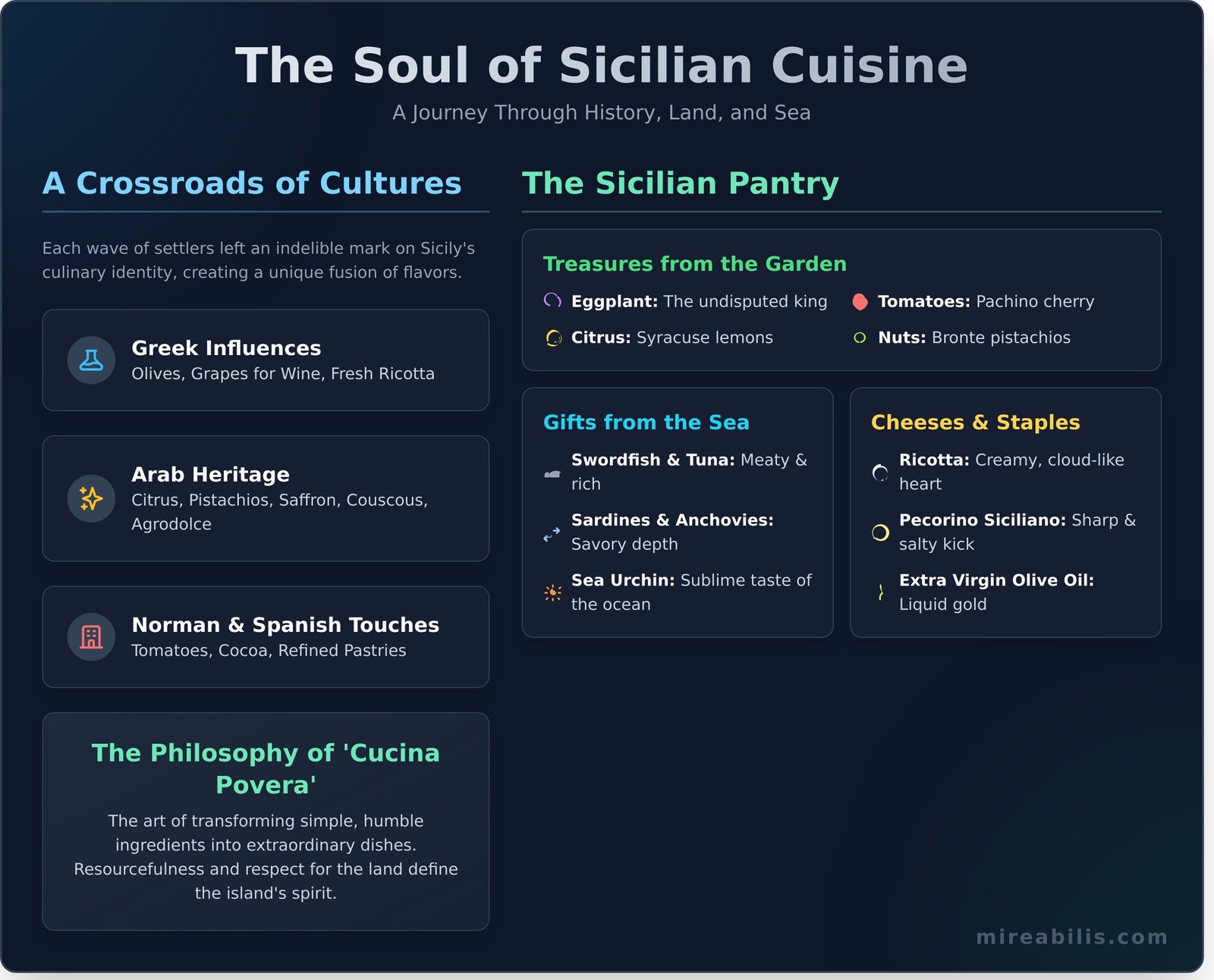
Every bite of Sicilian food is a journey through history. The island’s strategic position in the Mediterranean made it a coveted prize, and each wave of settlers left an indelible mark on its culinary identity. This rich tapestry of influences is what makes the study of Sicilian cuisine so fascinating, creating a stunning and unique fusion of flavors:
-
Greek Influences: The ancients brought olives, grapes for wine, and the art of making fresh ricotta-foundations that endure to this day.
-
Arab Heritage: A golden age that introduced lemons, oranges, pistachios, almonds, and saffron, along with couscous and the iconic sweet-and-sour agrodolce profile.
-
Norman & Spanish Touches: Later arrivals introduced ingredients from the New World, like tomatoes and cocoa, and refined the island’s passion for intricate pastries and sweets.
The Philosophy of ‘Cucina Povera’ (Peasant Cooking)
At the heart of Sicily’s culinary soul is cucina povera. This isn’t about poverty, but about a profound philosophy of resourcefulness and respect for the land. It is the art of transforming simple, humble ingredients into something truly extraordinary. Think of pasta tossed with wild foraged fennel and sardines, or using every part of a vegetable, from leaf to root. This approach ensures nothing is wasted and creates dishes that are bold, honest, and bursting with authentic flavor-a testament to the ingenuity that defines the island’s spirit.
The Sicilian Pantry: Essential Flavors from Land and Sea
To truly understand the heart of Sicilian cuisine, you must first explore its pantry-a treasure trove of ingredients shaped by volcanic soil, relentless sun, and the deep blue Mediterranean. This is where the story of every unforgettable dish begins, a vibrant dialogue between the island’s fertile land and its bountiful sea. These are not just ingredients; they are the very essence of Sicily, each with a unique story and a distinct sense of place.
Treasures from the Garden
The Sicilian garden is a sun-drenched paradise, yielding produce with an intensity of flavor rarely found elsewhere. The undisputed king is the eggplant or aubergine, whose silky texture forms the foundation of iconic dishes. You will find the world’s most vibrant produce here, including:
-
Tomatoes: From the incredibly sweet Pachino cherry tomatoes grown on the southeastern coast to sun-dried varieties that offer a concentrated burst of summer.
-
Citrus: The zesty perfume of lemons from Syracuse, the sweet juice of Tarocco blood oranges from the slopes of Mount Etna, and the bright notes of mandarins are essential to both sweet and savory recipes.
-
Nuts & Herbs: The famous "green gold" pistachios from Bronte, creamy almonds from Noto, the anise-scented wild fennel, and the sharp, salty tang of capers from the island of Pantelleria.
Gifts from the Sea
Surrounded by three seas, Sicily’s culinary identity is intrinsically linked to its maritime harvest. The daily catch dictates the menu in coastal towns, where simplicity is key to honoring the freshness of the ingredients. Staples include meaty swordfish and rich tuna, often grilled with just a squeeze of lemon and a drizzle of olive oil. Humble yet powerful, sardines and anchovies provide a savory depth to countless pasta sauces, while the prized sea urchin offers a sublime, briny taste of the ocean in a single spoonful.
Local Cheeses and Staples
No exploration of authentic sicilian cuisine is complete without its essential dairy and staples. Fresh, creamy Ricotta is the cloud-like heart of both desserts like cannoli and savory pasta fillings. In contrast, Pecorino Siciliano, an aged sheep’s milk cheese, provides a sharp, salty kick. Tying everything together is the island’s liquid gold: extra virgin olive oil. Peppery, grassy, and robust, it is the lifeblood of nearly every dish, a fundamental flavor that captures the very soul of Sicily.
From the Streets to the Trattoria: Must-Try Sicilian Dishes
To truly understand Sicily is to taste it. The island’s culinary story unfolds not in a single meal, but in a series of unforgettable moments-a warm snack from a street vendor, a perfectly crafted pasta in a family-run trattoria, a sweet indulgence by the sea. Let us guide you through the essential dishes that define authentic sicilian cuisine, a journey from the vibrant streets to the heart of the Sicilian table.
The Art of Street Food (Cibo di Strada)
Your adventure begins in the bustling markets, where the air is rich with tantalizing aromas. Here, you’ll discover a world of flavor meant to be enjoyed on the go.
-
Arancini: These golden, fried rice balls are a Sicilian icon. While the classic filling is a rich ragù, you’ll find endless variations. Notice their shape: typically round in Palermo and conical on the eastern coast, inspired by Mount Etna.
-
Panelle e Crocchè: A classic Palermo sandwich, this soft bun is filled with crispy chickpea fritters (panelle) and creamy potato croquettes (crocchè). It’s simple, satisfying, and utterly delicious.
-
Sfincione: Often described as Sicilian pizza, this is something else entirely. Imagine a thick, spongy, focaccia-like bread topped with a savory sauce of tomato, onion, anchovies, and caciocavallo cheese.
Primi Piatti: The Heart of the Meal
Moving into the trattoria, the first course, or primo, is often a masterpiece of pasta. Each dish tells a story of its regional origins and the island’s bountiful ingredients.
-
Pasta alla Norma: A tribute to Catania, this dish features pasta tossed in a fresh tomato sauce with fried eggplant, crowned with a generous grating of salted ricotta (ricotta salata) and fresh basil.
-
Pasta con le Sarde: A signature of Palermo, this dish perfectly captures the island’s Arab-Sicilian influence with a complex sauce of fresh sardines, wild fennel, pine nuts, and raisins.
-
Busiate alla Trapanese: From Trapani comes this elegant corkscrew pasta served with a vibrant, raw pesto of ripe tomatoes, fresh basil, garlic, and local almonds.
Secondi: Masterpieces of Land and Sea
The main course showcases the freshest ingredients from Sicily’s fertile land and the surrounding Mediterranean waters, prepared with rustic elegance.
-
Pesce Spada alla Ghiotta: A magnificent swordfish steak cooked in a bold and savory "glutton’s sauce" of tomatoes, capers, olives, and celery.
-
Sarde a Beccafico: A humble yet brilliant dish of butterflied sardines rolled around a sweet and savory filling of breadcrumbs, pine nuts, and raisins, then baked until golden.
-
Involtini Siciliani: These thinly sliced rolls of veal or swordfish are filled with a flavorful mixture of breadcrumbs, cheese, and herbs, offering a tender and aromatic bite.
Dolci: An Unforgettable Sweet Finale
No exploration of sicilian cuisine is complete without indulging in its legendary desserts. These sweet creations are a testament to centuries of tradition and artistry.
-
Cannoli: The undisputed king of Sicilian pastries. A crispy, fried pastry tube is filled just before serving with a luscious, sweetened ricotta cream, often studded with chocolate chips or candied fruit.
-
Cassata Siciliana: A true baroque masterpiece, this decadent sponge cake is layered with sweet ricotta and wrapped in a vibrant green marzipan shell, adorned with candied fruits.
-
Granita with Brioche: The quintessential Sicilian breakfast. This semi-frozen dessert, with intense flavors like lemon, almond, or coffee, is served with a soft, cloud-like brioche bun for dipping.
Beyond the Plate: A Journey into Sicilian Wine and Spirits
To truly understand Sicilian cuisine is to look beyond the food and embrace the island’s liquid treasures. Sicily, an ancient land of vines, is experiencing a breathtaking renaissance in winemaking. Its sun-drenched hills and the dramatic, mineral-rich volcanic soils of Mount Etna create a terroir unlike any other, producing wines and spirits that are as bold, complex, and unforgettable as the island itself. A meal here is incomplete without the perfect glass to accompany it, a tradition that transforms dining into a complete sensory journey.
The Wines of Sicily: From Etna to Marsala
From the fiery slopes of Europe’s most active volcano to the sun-baked western coast, Sicily offers a diverse and exceptional wine landscape. Each bottle tells a story of its unique origin, a narrative of sun, soil, and sea.
-
Mount Etna Wines: Grown on high-altitude volcanic terroir, these are some of Italy’s most elegant wines. Discover the perfumed, Burgundian-style reds from the Nerello Mascalese grape and the crisp, mineral-driven whites from Carricante.
-
Nero d’Avola, Frappato and Cerasuolo di Vittoria: Sicily’s most celebrated red grapes, Nero d’Avola and Frappato, produce bold, ruby-red wines bursting with flavors of dark cherry, plum, and spice. When assembled together with craft and mastery, they produce the famous Ceerasuolo di Vittoria, a pure, warm essence of the Sicilian sun captured in a glass.
-
Marsala Wine: This historic fortified wine is making a magnificent comeback. Ranging from dry (secco) aperitifs to sweet (dolce) dessert wines, a true artisanal Marsala is a complex and deeply satisfying experience.
Digestivi and Local Liqueurs
The Sicilian meal does not end when the plates are cleared; it concludes with a cherished ritual of coffee and digestivi. These after-dinner drinks are designed to soothe the stomach and encourage lingering conversation, encapsulating the island’s spirit of hospitality.
-
Amaro Siciliano: Every region has its own secret recipe for this bittersweet herbal liqueur. An amaro, with its complex blend of botanicals like orange peel and licorice, is the traditional way to settle a satisfying meal.
-
Limoncello & Co.: Made from the island’s famously fragrant lemons, a chilled glass of Limoncello is pure sunshine. Look also for other artisanal liqueurs infused with local blood oranges, mandarins, or wild fennel.
-
Caffè: The final, essential note is a perfectly pulled espresso. Rich, intense, and aromatic, it is a moment of pure pleasure and the definitive punctuation mark on an authentic experience of Sicilian cuisine.
Exploring these remarkable drinks is an essential part of any authentic Sicilian adventure. Allow us to curate a bespoke tasting journey for you, from exclusive cellar visits to perfect pairings. Discover the soul of Sicily with Mireabilis, where we dared to craft some exquisite olives, liqueurs and confitures with 100% bio fruits from our own orchard.
How to Experience Authentic Sicilian Cuisine Like a Local
To truly understand the island’s soul, you must go beyond the menu. Experiencing authentic Sicilian cuisine is not just about what you eat, but how you connect with the culture, the land, and the people who bring these incredible flavors to life. It’s an adventure for the senses, an invitation to be curious and step away from the well-trodden tourist path.
Tips for an Authentic Culinary Adventure
To connect with the island’s most genuine flavors, you must immerse yourself in its daily rhythms. This is where the real magic happens.
-
Visit the Local Markets: Wander through the vibrant chaos of a market like Ballarò in Palermo. Here, amid the calls of vendors, the brilliant colors of fresh produce, and the scent of street food, you will find the true heart of the island’s food culture.
-
Eat Seasonally: The most memorable meals are born from what is freshest. Don’t be afraid to ask your host or waiter, "Cosa c’è di stagione?" (What’s in season?). This simple question unlocks the most vibrant and unforgettable flavors.
-
Seek out an Agriturismo: For an incredible meal, escape to the countryside. These working farm-stays, somewhat equivalent to a french auberge, offer rustic, home-cooked dishes made with ingredients grown just steps from your table. It is honest, generous, and deeply Sicilian.
Go Deeper with a Curated Experience
While self-discovery is a rewarding adventure, some secrets of the Sicilian table are best revealed with a trusted guide. A curated experience transforms a great meal into a lifelong memory, connecting you to the people and stories behind the food.
Imagine learning the art of pasta-making from a local chef in their own kitchen or being led through winding city streets to a hidden bakery you would never find alone. A bespoke holiday allows you to build an entire trip around your culinary passions, from private vineyard tours on the slopes of Etna to exclusive seafood feasts on the coast.
This is more than a holiday; it’s a personal journey into the heart of Sicilian hospitality. Let us design your bespoke culinary journey through Sicily.
Your Sicilian Culinary Story Awaits
As you have discovered, the soul of Sicily is expressed on the plate. It is a captivating story told through sun-ripened ingredients from the land and the day’s catch from the sea, a culinary tradition wonderfully distinct from the Italian mainland. From the vibrant energy of street food to the quiet elegance of a family trattoria, every meal is an invitation to understand the heart of authentic sicilian cuisine.
But to truly understand this rich tapestry of flavor, you must experience it for yourself. This is more than a holiday; it is an immersion. We craft bespoke culinary itineraries tailored to your tastes, arranging everything from private cooking classes with passionate local chefs to exclusive access to local vineyards and family-run farms, ensuring your journey is as unique as the island itself.
Start planning your unforgettable Sicilian food adventure with us. Your table in the Mediterranean sun is waiting.
Frequently Asked Questions About Sicilian Cuisine
What is a typical Sicilian breakfast?
Imagine starting your day with the Mediterranean sun. A typical Sicilian breakfast, or colazione, is a sweet, simple affair. The most beloved tradition is a refreshing almond or coffee granita served with a warm, soft brioche bun, famously known as brioche col tuppo. This is often enjoyed at a local bar, accompanied by a strong espresso. It’s a light, delightful ritual that prepares you for a day of discovery on this beautiful island.
Is Sicilian food very spicy or hot?
While rich in flavor, Sicilian food is generally not overwhelmingly spicy. The complexity comes from aromatic herbs, the influence of sweet and sour agrodolce sauces, and the freshness of local ingredients. While a hint of red chili flake, or peperoncino, might appear in certain dishes, it is used with a delicate touch to add warmth rather than intense heat. The focus is always on balancing the beautiful, sun-kissed flavors of the island.
What is the most famous or iconic dish in Sicily?
While it’s difficult to choose just one, many would point to arancini as a true icon of Sicilian cuisine. These golden, fried rice balls, filled with ragù or other delightful ingredients, are the island’s quintessential street food. Other beloved contenders for the most famous dish include Pasta alla Norma, an exquisite pasta dish from Catania with eggplant and ricotta salata, the world-renowned cannolo, a crisp pastry tube filled with sweet ricotta cream and, of course, the ice-cold super refreshing and 100% natural flavoured granitas.
Are there differences in cuisine between Eastern and Western Sicily?
Absolutely. The island’s diverse history is beautifully reflected in its regional food. Western Sicily, with its proximity to Africa, shows a strong Arab influence in dishes like couscous alla trapanese. In the East, Greek heritage shines through with a greater emphasis on fresh vegetables, as seen in the iconic Pasta alla Norma from Catania. Exploring these subtle yet distinct culinary landscapes is one of the great joys of travelling through Sicily, a true journey for the senses.
What are some must-try vegetarian dishes in Sicily?
Sicily is a paradise for vegetarians, celebrating the island’s bountiful produce. A must-try is caponata, a sublime sweet and sour eggplant stew that captures the essence of the island’s flavors. You cannot miss Pasta alla Norma, a masterpiece of pasta, fried eggplant, tomato, and salted ricotta. For a taste of Palermo’s street food culture, seek out panelle, which are delicious, crispy chickpea fritters often served in a fresh bread roll.
Do I need to tip at restaurants in Sicily?
Tipping in Sicily, and Italy in general, is not a required practice. You will often see a coperto (cover charge) on your bill, which covers the bread and service. While not expected, if you receive truly exceptional and personal service, leaving a few extra euros as a gesture of appreciation is always warmly received. It is a small way to acknowledge a memorable dining experience, but it is never considered an obligation.