
Last June, a group of six friends stood in the golden silence of Scicli’s Via Mormino Penna, realizing they hadn’t seen a single 50-passenger tour bus all afternoon. You likely know that planning a refined baroque sicily itinerary through a region as vast as the Val di Noto feels overwhelming. The sheer scale of the 1693 reconstruction effort left behind eight UNESCO cities that are nearly impossible to navigate via generic tours without losing the magic. It’s a constant challenge to coordinate logistics for a small group while seeking something truly authentic.
We’ve designed a bespoke journey that replaces logistical stress with a refined, small-group approach centered at our sanctuary in Scicli. You’ll gain a small measure of peace as you explore the honey-hued streets of Ragusa Ibla and the 4th-century mosaics of Villa Romana del Casale. This guide previews our unique fusion of architectural heritage, active adventures like e-biking through limestone canyons, and the soul-stirring flavors of the island. We’ll show you how to experience South and East Sicily as a personal guest, discovering the hidden stories that define this sun-drenched landscape.
Key Takeaways
- Understand how the 1693 earthquake transformed the Val di Noto into a UNESCO-listed landscape of architectural splendor and rebirth.
- Master the “Golden Triangle” by exploring a curated baroque sicily itinerary that balances the symmetry of Noto with the labyrinthine charm of Ragusa Ibla and Modica.
- Discover why Scicli serves as the perfect “hidden gem” base, offering a small measure of peace and a seamless hub-and-spoke model for your journey.
- Preview a bespoke 7-day flow that blends 18th-century palace visits with active land and sea adventures tailored to your group’s unique rhythm.
- Learn how to design a truly personal Sicilian escape with Mireabilis, where every itinerary is hand-crafted to convert guests into lifelong friends.
The Rebirth of the Val di Noto: Understanding the Sicilian Baroque Legacy
The sun sets over the limestone hills of Southeast Sicily, casting a warm, honey-colored glow that feels like a personal invitation to explore. This corner of the island, known as the Val di Noto, holds a story of resilience and artistic triumph. It’s the essential starting point for any baroque sicily itinerary. Here, history is etched into the very stone of the buildings. The landscape consists of deep canyons and rugged plateaus, providing a dramatic backdrop for some of the world’s most beautiful architecture.
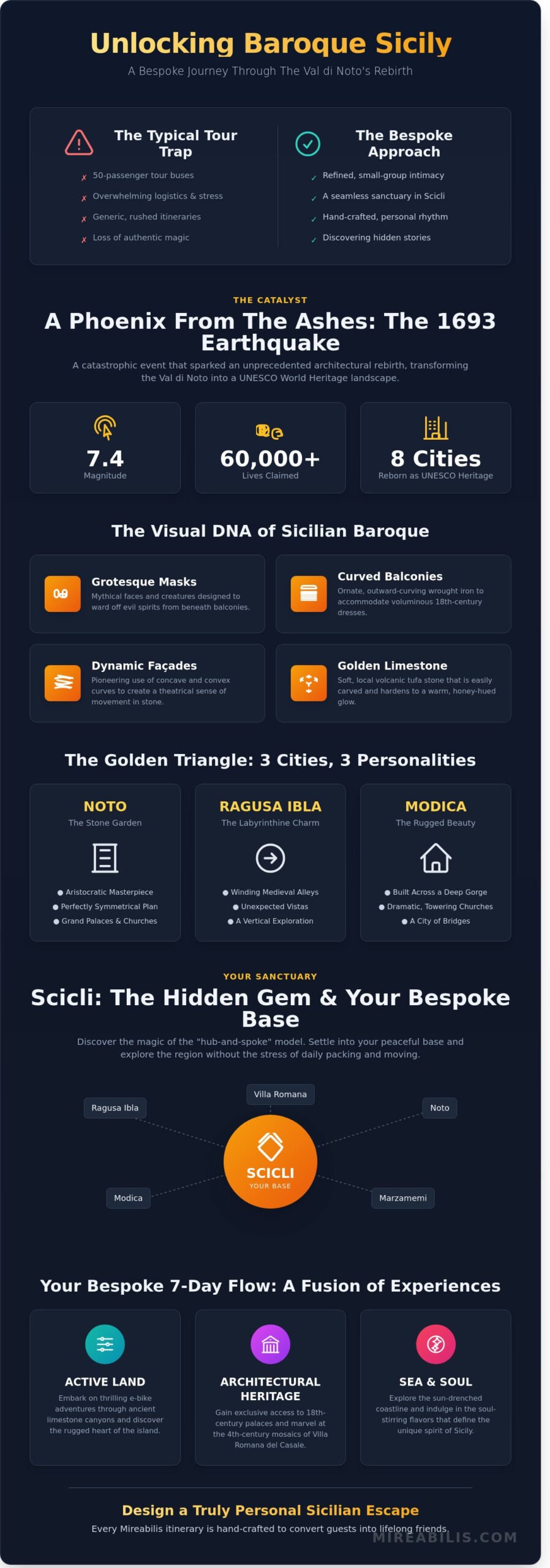
On January 11, 1693, a massive earthquake, estimated at a magnitude of 7.4, ripped through the region. It leveled more than 50 towns and claimed approximately 60,000 lives. While the disaster was catastrophic, the response was unprecedented. Instead of simply patching up the ruins, the local population and the ruling Spanish aristocracy chose to rebuild entirely. They created a unified, theatrical style that we now celebrate as Sicilian Baroque. This collective effort earned eight of these towns a place on the UNESCO World Heritage list in 2002, protecting their soul for future generations.
The 1693 Earthquake: A Phoenix from the Ashes
The reconstruction moved with surprising speed. Within a few decades, entire cities rose again from the rubble. The builders used local yellow-gold limestone, a soft volcanic rock that’s easy to carve but hardens over time. Did you know that the reconstruction was fueled by a fierce rivalry? Local aristocrats in towns like Ragusa and Modica competed to build the most lavish palaces and churches, each trying to outshine their neighbor. This competitive spirit resulted in the breathtaking density of beauty you see today. At Villa Mireabilis in Scicli, you’re perfectly positioned to witness this legacy firsthand, nestled in a canyon where the stone seems to glow with Mediterranean warmth.
Defining Features of the Sicilian Baroque
You’ll know you’re looking at Sicilian Baroque when you see the “grotesque masks” staring back from beneath stone balconies. These grinning faces and mythical creatures were designed to ward off evil spirits. The wrought-iron balconies themselves are masterpieces, often curving outward to accommodate the voluminous dresses of 18th-century noblewomen. Architects like Rosario Gagliardi pioneered the use of concave and convex facades, creating a sense of movement in the stone. This theatricality is a core element of your baroque sicily itinerary, turning a simple walk through Scicli or Noto into a journey through a living museum.
Every town square feels like an open-air stage designed for the drama of daily life. The churches don’t just sit on the street; they command it with towering belfries and wide, welcoming staircases. These structures invite you to find a small measure of peace within their cool, silent interiors. The style is a bespoke fusion of Spanish flair and local craftsmanship, creating an unforgettable atmosphere that defines the spirit of Southeast Sicily. It’s a place where the past isn’t just remembered; it’s performed in every carved cherub and sweeping piazza.
The Golden Triangle: Exploring Noto, Ragusa Ibla, and Modica
The 1693 earthquake changed the face of South Sicily forever. Out of the rubble of the Val di Noto rose a theatrical landscape of honey-hued limestone and dramatic facades. This reconstruction birthed what is now recognized as a UNESCO World Heritage Site, a collection of towns that define the peak of the Baroque movement. For anyone crafting a baroque sicily itinerary, these three cities represent the “Golden Triangle,” each offering a distinct personality within a shared architectural language. While Noto feels like a stage set for an opera, Ragusa Ibla and Modica offer a more rugged, vertical exploration of Sicily’s soul.
Noto: The Aristocratic Masterpiece
Noto is often called the “Stone Garden” because of the soft, volcanic tufa stone that glows with a deep gold hue as the sun sets. The city was moved 10 kilometers from its original site after the earthquake, allowing architects like Rosario Gagliardi to design a perfectly symmetrical urban plan. Walking along the Corso Vittorio Emanuele, you’ll encounter the Cathedral of San Nicolò. After its dome tragically collapsed in 1996, a decade of meticulous restoration allowed it to reopen in 2007, looking more radiant than ever. Just a few steps away, Palazzo Nicolaci showcases the era’s flair with its grotesque balconies featuring lions, sirens, and winged horses.
If you visit during the third weekend of May, you’ll witness the Infiorata di Noto. Local artists use over 400,000 flower petals to create intricate mosaics along Via Nicolaci. It’s a sensory explosion that pairs perfectly with a stop at Caffè Sicilia. Founded in 1892, this legendary spot serves an almond granita so creamy it defies description. Taking a moment to enjoy it in the shadow of the Duomo offers that small measure of peace we all seek on a baroque sicily itinerary.
Ragusa Ibla and Modica: A Tale of Two Tunnels
Ragusa is a city of two halves. In 1834, the population split into Ragusa Superiore, the modern upper town, and Ragusa Ibla, the lower ancient district. Ibla is a labyrinth of 18th-century palaces perched on a limestone ridge. It feels intimate and ancient, with narrow alleys that lead to the magnificent Duomo di San Giorgio. The facade is a masterpiece of verticality, a theme that continues in nearby Modica. Known as the “city of 100 churches,” Modica is built into the walls of a steep canyon. The Duomo di San Giorgio here is equally impressive, requiring a climb of 250 steps to reach its towering facade.
Modica is also the guardian of a 400-year-old chocolate tradition. Unlike modern chocolate, Modica’s version is cold-processed, never exceeding 45°C. This technique, brought by the Spanish from the Aztecs, keeps the sugar crystals intact, resulting in a unique, crumbly texture. You can taste the history in every bite of the cinnamon or chili-infused bars. When you stay at Villa Mireabilis in Scicli, these culinary and architectural wonders are just a short journey through the rolling Hyblaean hills.
Practical Tip: Beating Baroque Fatigue
To truly appreciate these sites without feeling overwhelmed by “Baroque fatigue,” follow these steps:
- Limit your exploration to one town per morning or afternoon.
- Focus on the details of three specific buildings rather than trying to enter every church.
- Schedule a long lunch between 1:00 PM and 3:00 PM when the sun is strongest and the towns are quietest.
- Switch your focus from architecture to flavors, like trying the local scaccia (stuffed flatbread) in Ragusa.
Scicli: The Living Museum and Your Bespoke Base
Scicli remains the valley’s best-kept secret, tucked away where three limestone canyons meet. While crowds flock to Noto’s main street or the heights of Ragusa Ibla, Scicli offers an authentic, unhurried rhythm that feels like stepping back in time. It’s a town carved directly into the rock. The Chiafura caves, which pierce the cliffside, housed over 2,000 residents as late as 1958 before they were relocated to the modern town. This canyon setting creates a natural amphitheater, where golden stone buildings glow under the Mediterranean sun. It’s the perfect anchor for your baroque sicily itinerary, providing a sense of discovery that larger cities often lose to tourism.
Scicli’s Cultural Treasures
The architecture here is more than just stone; it’s a theatrical performance. Palazzo Beneventano stands as the crowning jewel of this UNESCO World Heritage Site. In 1968, the art historian Sir Anthony Blunt famously labeled it the most beautiful baroque palace in Sicily, largely due to its eccentric, snarling gargoyles and expressive balconies. If you visit during Easter, you’ll witness the “Uomo Vivo” festival. This isn’t a somber procession. Instead, the town erupts in joy as a statue of Christ is carried at a run through the streets, a tradition that has unified the community for centuries. Fans of Italian culture might also recognize the Town Hall on Via Francesco Mormino Penna. Since 1999, it has served as the fictional police station for the “Inspector Montalbano” series, drawing visitors into the cinematic heart of the island.
Why a Hub-Based Itinerary Wins
Constantly moving between hotels drains the energy of any journey. A hub-and-spoke model allows you to unpack once and truly inhabit the space. By choosing Scicli as your base, you eliminate the friction of daily check-ins and the sterile feel of impersonal lobbies. You’ll start to recognize the local baker who pulls fresh scaccia from the oven at 7:00 AM. You’ll find your favorite corner for an evening aperitivo. This stability is what grants you “a small measure of peace” amidst a busy baroque sicily itinerary. It transforms a trip into a lived experience where the town becomes your home rather than just a backdrop.
Returning to a private estate like Villa Mireabilis each evening elevates this concept to a premier level of exclusivity. Nestled just five miles from the sea, this retreat offers a bespoke environment that hotels can’t replicate. It’s designed for small groups seeking a tailor-made escape, featuring a nearly closed energy circle that honors the local environment. You won’t find crowds or automated booking systems here. Instead, you’ll find a personal invitation to experience Sicily’s soul with hosts who treat every guest like a friend. This private sanctuary provides the quiet reflection needed after a day of exploring sun-drenched cathedrals and ancient canyons.
A 7-Day Bespoke Baroque Itinerary: Land, Sea, and Soul
This 7-day journey is a personal invitation to discover the soul of South East Sicily. We’ve curated a flow that balances the architectural grandeur of UNESCO sites with the raw energy of the Mediterranean landscape. Your baroque sicily itinerary begins in the limestone canyons of Scicli, where the 1693 earthquake’s destruction paved the way for the ornate rebirth you see today. This isn’t a rushed checklist; it’s a slow immersion into a region where time feels beautifully suspended.
Days 1 and 2 focus on the “Golden Triangle.” You’ll spend your first 48 hours immersed in Scicli, Modica, and Ragusa. These towns represent the peak of late Baroque flair. You’ll walk streets where every balcony tells a story through carved stone cherubs and grotesque masks. By day 3, we transition from stone to salt. We’ll set sail from Marina di Ragusa, heading toward the dramatic white cliffs that line the southern coast. In Siracusa, the ancient island of Ortigia offers a 2,500-year-old history lesson wrapped in salty sea breezes.
The final days elevate the pace. You’ll e-bike through the labyrinthine paths of the Hyblaean hills before taking to the skies. A private flight over Mount Etna reveals the sheer scale of Europe’s most active volcano. It’s a stark, powerful contrast to the delicate carvings found in the Val di Noto. Every moment is tailor-made to ensure you find a small measure of peace amidst the adventure.
The Land and Sea Fusion
Experience the island from two distinct perspectives. Our sailing adventures depart from the modern harbor of Marina di Ragusa, tracing the coastline where the Mediterranean meets the Ionian Sea. On land, guided e-biking tours navigate the ancient network of dry-stone walls. These walls, recognized by UNESCO in 2018, frame the rural paths between Modica and Scicli. To ground yourself in local tradition, join a private chef to master the art of “scacce.” This traditional Ragusan flatbread, layered with tomato and local caciocavallo cheese, is the authentic flavor of the Sicilian countryside.
A Detailed Day Tour: The Heart of the Val di Noto
This curated day begins and ends at your home base in Scicli, offering a deep dive into the baroque sicily itinerary highlights.
- Start: Wake up in the quiet luxury of Scicli. Enjoy a morning coffee on Via Mormina Penna, a street so beautiful it serves as a living film set for international productions.
- Late Morning: Meet your guide at Palazzo Beneventano. It’s often cited as Sicily’s most beautiful building due to its expressive, “shouting” balcony supports and anthropomorphic masks.
- Lunch: Travel to Modica Alta for a slow meal. Try the handmade “cavatelli” at an exceptional local restaurant overlooking the rooftops of the lower town.
- Afternoon: Explore the hidden gardens of Ragusa Ibla. These lush, private oases are tucked behind heavy wooden doors and grand baroque facades.
- End: Return to Scicli. Watch the limestone cliffs turn pink during a sunset aperitivo at Villa Mireabilis.
Ready to experience the magic of the Val di Noto with a host who treats you like a friend? Book your bespoke adventure at Villa Mireabilis today.
Designing Your Private Baroque Adventure with Mireabilis
At Mireabilis, we believe that travel shouldn’t feel like a transaction. Our core philosophy centers on converting every guest into a personal friend. We don’t just hand you a map; we share our home and our heritage. Your baroque sicily itinerary is crafted through a series of personal conversations to ensure the pace matches your group’s unique rhythm. Whether you seek the adrenaline of off-road exploration or the quiet contemplation found in a 17th-century cloister, we balance the scales to create a perfect harmony. This is not a standard tour; it’s a curated experience designed to connect you with the soul of the island.
Sustainability is our way of life rather than a marketing tactic. Our estate operates on a nearly closed energy circle, utilizing 95% renewable sources to power the entire property. We prioritize eco-friendly transport options, including our fleet of high-performance e-bikes for guided journeys that leave no carbon footprint on the Hyblaean hills. This commitment ensures that the breathtaking landscapes of Scicli and Ragusa remain pristine for generations. We believe in stewardship that honors the land while providing a luxury experience. By choosing us, you support a model of tourism that respects the delicate balance of our Mediterranean environment.
Moving from inspiration to reality is a seamless, collaborative process. We take your initial ideas and transform them into a detailed, tailor-made proposal within 48 hours of our first conversation. This approach removes the stress of logistics, allowing you to focus entirely on the anticipation of your Sicilian discovery. We handle the intricacies so you can enjoy the freedom of the journey. Every proposal is a starting point, refined until it perfectly mirrors your vision of an unforgettable group holiday.
The Small Group Advantage
Traveling with a limited number of guests unlocks doors that remain firmly closed to the masses. We provide exclusive access to private vineyards in the Val di Noto and 4th-generation family-owned farms where traditional Ragusano DOP cheese-making remains a sacred art. You won’t find impersonal online bookings or crowded tour buses here. Your dedicated Mireabilis host acts as a cultural bridge, uncovering hidden stories of the 1693 earthquake and the resilient spirit of the people who rebuilt these stone cities.
Your Invitation to Sicily
Our bespoke planning process is a personal invitation to experience the island’s authentic flair. We offer a unique fusion of land and sea adventures, from quad biking through rugged canyons to culinary classes focusing on ancient grain pasta. Every detail is curated to provide a small measure of peace. We invite you to step away from the noise of the world and into a landscape where time slows down. Let’s talk about your group’s dream journey; we are ready to listen.
Begin Your Sicilian Renaissance in the Val di Noto
You’ve discovered how the 1693 earthquake transformed the Val di Noto into a limestone masterpiece. From the tiered streets of Ragusa Ibla to the century-old chocolate traditions of Modica, your baroque sicily itinerary is a gateway to a world that feels both ancient and revitalized. Choosing Scicli as your base places you in a UNESCO Cultural Heritage site recognized in 2002 for its unique architectural integrity. It’s a town where history lives in the golden stone of every palazzo and church.
At Mireabilis, we reject the noisy crowds of commercial tourism. Our estate operates with a nearly closed energy circle to ensure your stay respects the Sicilian landscape we call home. We curate bespoke adventures that blend the warmth of the land with the sapphire clarity of the Mediterranean. Whether you’re exploring the 18th-century facades of Noto or finding a small measure of peace in our hidden canyons, we don’t believe in one-size-fits-all travel. Every journey is a personal invitation to experience the authentic soul of South East Sicily.
Ready to make Mireabilis your next adventure base? Let’s talk!
We can’t wait to share the magic of our island with you.
Frequently Asked Questions
What is the best time of year to follow a Baroque Sicily itinerary?
The best time to follow a baroque sicily itinerary is during the spring months of April, May, and June, or the golden autumn of September and October. These periods offer mild temperatures between 18°C and 25°C, which are perfect for exploring limestone streets without the 40°C heat of August. You can witness the Infiorata di Noto on the third Sunday of May, where artists cover Via Nicolaci in millions of flower petals.
How many days do I need to see the UNESCO Baroque towns?
You need 7 to 10 days to fully appreciate the 8 UNESCO-listed towns of the Val di Noto. This timeframe allows you to wander through the labyrinthine streets of Ragusa Ibla and Modica before finding a small measure of peace in Scicli. Spending at least 48 hours in each major hub ensures you catch the light hitting the golden facades at sunset, a sight that defines the region’s 17th-century architecture.
Is the Val di Noto suitable for small children or elderly travelers?
The Val di Noto is excellent for all ages when your journey is tailor-made to balance activity with rest. While towns like Modica have 100 steps to reach the San Giorgio Cathedral, Scicli offers a flatter, more accessible landscape for those with limited mobility. Since the 2002 UNESCO listing, 60 percent of major historical sites have added accessibility features. We ensure your pace remains relaxed, focusing on comfort and authentic connection.
Can I combine a cultural baroque tour with active adventures like sailing?
You can easily blend a cultural baroque sicily itinerary with sailing adventures along the Mediterranean coast. Our base in Scicli sits just 5 miles from the sea, allowing you to spend the morning among 18th-century palaces and the afternoon on a 50-foot yacht. This fusion of land and sea provides a unique perspective of the coastline, where the turquoise water meets the rugged limestone cliffs of Southeast Sicily.
What makes Scicli different from other baroque towns in the region?
Scicli stands out because it remains an authentic, living community rather than a museum piece. Nestled in a stunning natural canyon where three valleys meet, it offers a more intimate atmosphere than its larger neighbors. Since 1999, the town has gained fame as the backdrop for the Inspector Montalbano series. Its charm lies in the 100 stone masks of Palazzo Beneventano, which Jean-Pierre Houël described as Sicily’s most beautiful baroque palace in 1782.
Why should I choose a bespoke group holiday over a standard tour package?
A bespoke group holiday offers a personal invitation to the island’s soul that standard packages can’t match. We reject one-size-fits-all models, limiting our adventures to small groups of 8 to 12 guests to ensure intimacy. There’s no impersonal online booking here; instead, we craft a tailor-made experience that reflects your passions. This approach converts every guest into a personal friend, providing exclusive access to private palaces and hidden local flavors.
Are the UNESCO sites in Southeast Sicily accessible year-round?
Southeast Sicily’s UNESCO sites are open year-round, benefiting from 300 days of Mediterranean sunshine annually. Even in January, temperatures typically hover around 12°C, making it a quiet time to admire the architecture without the summer crowds. While some smaller museums might reduce their hours by 20 percent during the winter months, the major cathedrals and plazas remain vibrant hubs of local life and worship throughout all four seasons.
What should I pack for a mix of cultural tours and e-biking in Sicily?
Pack versatile layers and sturdy footwear to transition from 17th-century cathedrals to rugged coastal paths. For guided e-biking tours covering 30 kilometers of terrain, breathable fabrics and padded shorts are essential. You’ll also want smart-casual clothing with a bit of flair for evening meals at Villa Mireabilis. Don’t forget a high-SPF sunscreen, as the sun remains strong even during the shoulder seasons, providing that signature Mediterranean warmth.