
What if the true heart of Sicily isn’t found in the crowded streets of the north, but hidden within the golden limestone of the Val di Noto? While the island boasts seven distinct world heritage areas, roughly 60% of independent travelers find themselves overwhelmed by the sheer scale of the landscape. You likely want to feel a deep connection to the past without the stress of navigating tourist traps or dry, academic lectures. We understand that a holiday should be an invitation to wonder, not a race against a clock.
In this guide, you’ll learn how to experience a bespoke Sicily UNESCO world heritage tour that balances intellectual stimulation with a relaxed, personal pace. We’ll explore the 4th-century mosaics of Villa Romana del Casale and the soaring Greek theater of Siracusa through the eyes of those who call these places home. You’re about to preview a journey through the South and East that offers a small measure of peace and a lifetime of stories, culminating in a perfect day that begins and ends in the quiet elegance of Scicli.
Key Takeaways
- Uncover the historical layers of South-Eastern Sicily, where the legacies of Greeks, Romans, and Normans blend into a breathtaking landscape of ancient wonders.
- Embark on a bespoke sicily UNESCO world heritage tour to explore the world’s best-preserved Doric temples in Agrigento and the unparalleled Roman mosaics at Villa Romana del Casale.
- Delve into the theatrical artistry of the Val di Noto, from the “Living Baroque” architecture of Scicli and Ragusa to the iconic grotesque masks adorning Noto’s balconies.
- Experience the intangible heritage of the region by connecting with the spiritual intensity of Catania’s festivals and the authentic, soul-stirring flavors of Eastern Sicily.
- Plan a perfectly curated day of exploration that begins and ends at the peaceful Villa Mireabilis, featuring private chocolate tastings and architectural journeys through the heart of the island.
The Cradle of Civilisation: Contextualising South and East Sicily UNESCO World Heritage
Sicily’s south-eastern corner is a landscape defined by the dramatic tension between the fire of Mount Etna and the cool, turquoise depths of the Ionian Sea. This region serves as a living canvas where 3,000 years of human ambition are etched into the stone. From the volcanic slopes that provide fertile soil for ancient vineyards to the limestone plateaus of the Hyblaean Mountains, the geography has dictated the rise and fall of empires. Choosing a bespoke sicily UNESCO world heritage tour in this specific quadrant allows for a depth of discovery that a hurried trip across the entire island simply cannot provide. It is here that the soul of the Mediterranean feels most concentrated.
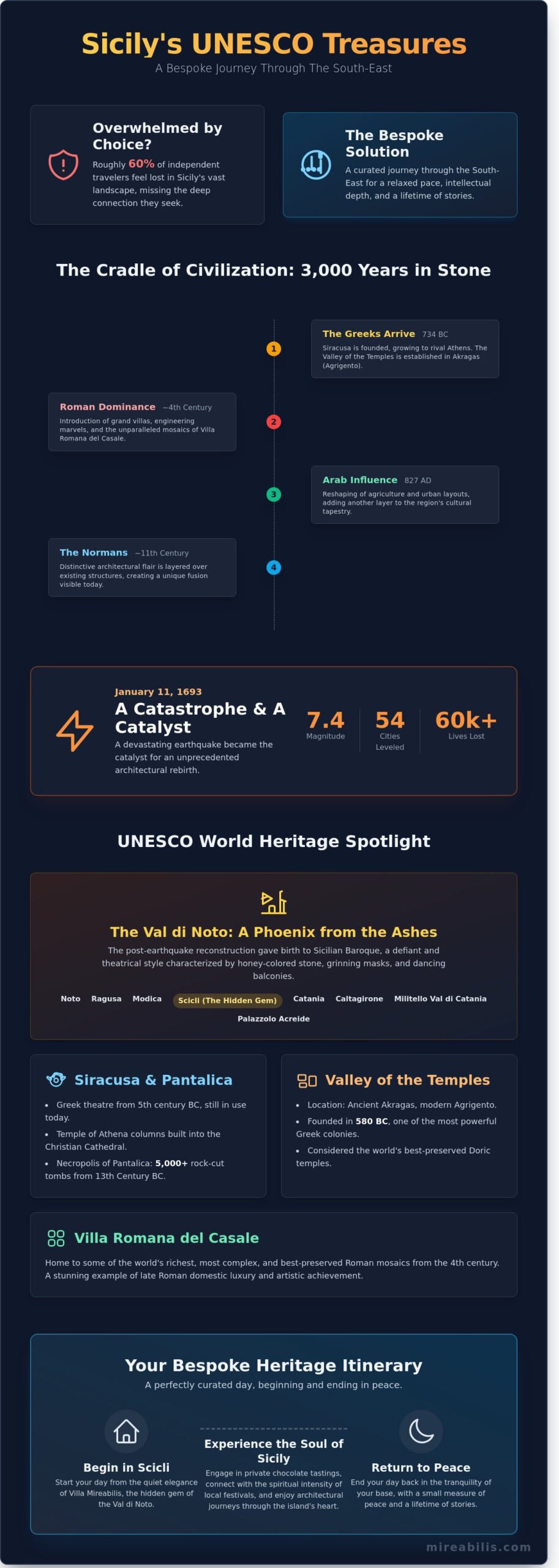
The historical layers of the East are remarkably dense. In 734 BC, Greek settlers transformed Siracusa into a capital that eventually rivalled Athens in power and beauty. Following the Greeks, the Romans introduced grand villas and engineering marvels. By 827 AD, Arab influence began to reshape the agriculture and urban layouts, followed by the Normans who layered their distinctive architectural flair over the existing structures. This fusion created a cultural tapestry that is entirely unique to the region. Instead of a generic holiday, a journey here becomes a personal invitation to witness how these disparate civilizations eventually merged into a single, vibrant identity.
The defining moment for the modern landscape occurred on January 11, 1693. A catastrophic earthquake, estimated at a 7.4 magnitude, leveled 54 cities and took over 60,000 lives. This tragedy became the catalyst for an unprecedented architectural rebirth. Rather than mourning the past, the survivors rebuilt with a defiant, theatrical joy. This era gave birth to the Sicilian Baroque, characterized by honey-colored stone, grinning masks, and curved balconies that seem to dance in the light. Focusing your exploration on this corner of the island ensures you experience the authentic rhythm of Sicilian life without the exhaustion of long travel days.
The Val di Noto: A Phoenix from the Ashes
The reconstruction after the 1693 disaster resulted in the collective UNESCO designation of the Val di Noto, a network of eight towns including Ragusa, Modica, and Noto. Spanish viceroys influenced the urban planning, but it was the local artisans who used the soft, golden limestone to create “the golden hour” effect. Scicli remains the hidden gem of this network. Nestled in a stunning natural canyon, it offers a small measure of peace away from the more crowded tourist paths, serving as the perfect base at Villa Mireabilis for those seeking an unforgettable, tailor-made adventure.
Siracusa and the Necropolis of Pantalica
Siracusa represents the pinnacle of ancient Mediterranean power. In the archaeological park of Neapolis, the Greek theatre still hosts performances today, just as it did in the 5th century BC. Nearby, the island of Ortygia displays a breathtaking fusion where the columns of the Temple of Athena are literally built into the walls of the Christian Cathedral. For a deeper connection to the prehistoric past, the Necropolis of Pantalica offers a hauntingly beautiful site. This limestone plateau contains over 5,000 rock-cut tombs dating back to the 13th century BC, providing a silent, powerful testament to the civilizations that flourished here long before the first Greek ships arrived on the horizon.
The Archaeological Giants: From the Valley of the Temples to Villa Romana del Casale
Stepping into the southern heart of the island feels like walking through a living gallery of human ambition. On a bespoke sicily UNESCO world heritage tour, the transition from the golden Greek ruins of the coast to the intricate Roman floors of the interior offers a profound sense of discovery. These sites represent a fusion of cultures that shaped the Mediterranean. They provide the historical foundation that eventualy led to the architectural triumphs described in the UNESCO World Heritage Centre listing for the nearby Val di Noto. You’ll find that these ancient stones tell stories of power, faith, and an unexpected level of domestic luxury.
Agrigento: A Walk Through the Gods
The journey begins in Akragas. Founded in 580 BC, this ancient Greek colony grew into one of the most powerful Mediterranean cities, leaving behind a skyline of honey-colored stone that still glows at sunset. The Valley of the Temples isn’t actually a valley; it’s a ridge that served as a beacon for sailors. You’ll walk the Sacred Way to witness the Temple of Juno, perched on the highest point, and the massive Temple of Olympian Zeus. Though now in ruins, the Zeus temple was once one of the largest Doric structures ever built, featuring Atlas-like figures called Telamons that stood nearly 8 meters tall.
The star of the ridge is the Temple of Concordia. It’s one of the best-preserved Greek temples on Earth, rivaling even the Parthenon. Did you know? The Temple of Concordia survived so perfectly because it was converted into a Christian church in 597 AD by Bishop Gregory of Agrigento. This sacred repurposing saved it from the stone-quarrying that destroyed its neighbors. If you visit in February, you’ll see the white almond blossoms creating a soft frame for the ancient stone, a sight that has inspired poets for centuries.
Villa Romana del Casale: The Roman Elite Life
Moving inland toward Piazza Armerina, the atmosphere shifts from public grandeur to private opulence. The 4th-century Villa Romana del Casale serves as a stunning testament to Roman luxury, preserved by a twist of fate. In the 12th century, a massive landslide covered the estate in a thick layer of mud. This natural seal protected over 3,500 square meters of vibrant mosaics from oxygen and looters until formal excavations began in 1950. Walking across the elevated walkways, you’ll see the sheer scale of Roman engineering, including sophisticated hypocaust underfloor heating systems that kept the elite warm during central Sicily’s crisp winters.
The storytelling within the tiles is breathtaking. The “Great Hunt” mosaic spans 60 meters and depicts the capture of tigers, elephants, and rhinos from across the Empire. However, most guests are drawn to the Room of the Ten Maidens. Popularly known as the “Bikini Girls,” these 4th-century figures are shown wearing two-piece athletic outfits while competing in weightlifting and running. It’s a vivid reminder that Roman life was far more modern than we often imagine. After a day exploring these giants, you’ll likely crave a small measure of peace. Our team at Mireabilis loves to welcome guests back to the quiet beauty of Scicli to reflect on these wonders over a glass of local Nero d’Avola.
- The Great Hunt: A 60-meter masterpiece showing the global reach of the Roman Empire.
- Bikini Girls: Mosaics proving that 4th-century women engaged in rigorous competitive sports.
- Preservation: 800 years of mud protection ensured the colors remain as vivid as the day they were laid.
Living Baroque: The Eight Wonders of the Val di Noto
The 1693 earthquake remains the most defining moment for South Eastern Sicily. It leveled 54 cities and claimed over 60,000 lives; however, from these ruins rose a theatrical architectural style known as Sicilian Baroque. When you join us on a sicily UNESCO world heritage tour, you’ll witness a landscape where honey-colored limestone glows under the Mediterranean sun. This region was collectively recognized as a UNESCO World Heritage Site in 2002 because of its unique architectural consistency and masterful urban planning.
Look up while walking through the narrow streets of Noto or Scicli. You’ll see “mascheroni,” the grotesque masks carved into the stone corbels supporting the balconies. These 18th-century carvings weren’t just decorative; they were designed to ward off evil spirits and mock the social anxieties of the era with their distorted, laughing faces. It’s this attention to detail that makes the Val di Noto feel like a living stage set, inviting you to slow down and observe.
Noto and Ragusa Ibla: The Baroque Masterpieces
Noto’s Corso Vittorio Emanuele is often called a “stone garden” because of its seamless flow of churches and palaces. The city was moved 8 miles from its original site after the 1693 disaster to ensure a grander, more rational layout. In Ragusa, the reconstruction sparked a fierce 18th-century rivalry between the “Sangiovannari” of the new Upper Town and the “Sangiorgiari” of the ancient Ibla. This competition gave us the Duomo di San Giorgio, designed by Rosario Gagliardi in 1738. It features a stunning triple-tiered facade that dominates the labyrinthine streets below.
Scicli: The Quiet Heart of the Heritage
The writer Elio Vittorini famously described Scicli as “the most beautiful city in the world” in his unfinished 1941 novel, Le città del mondo. It’s a place of profound peace, nestled in a natural canyon just five miles from the sea. The Palazzo Beneventano showcases some of the most complex Baroque decorations in Italy; its balconies are supported by stone monsters and winged putti. If you visit on March 19th, you’ll experience the Cavalcata di San Giuseppe. This festival sees horses draped in elaborate mantles of handmade silk flowers, a tradition that has unified the community for generations.
Tradition here is often edible. In Modica, the art of chocolate making follows a 16th-century Spanish legacy. The Spanish brought Aztec techniques from the New World, using cold-pressing at temperatures no higher than 40 degrees Celsius. This prevents the sugar from melting, giving the chocolate its signature grainy texture. The Antica Dolceria Bonajuto, established in 1880, still produces these bars without added fats or milk. It’s a taste of history that remains unchanged by modern industrial methods.
The Infiorata di Noto, held every third weekend of May since 1980, transforms Via Nicolaci into a 122-meter long tapestry of flower petals. Local artists spend 48 hours creating intricate mosaics from millions of blooms to celebrate spring and art. It’s a fleeting masterpiece that captures the vibrant soul of the region. We invite you to find your own small measure of peace among these golden stones, where every sicily UNESCO world heritage tour we curate is a personal invitation to discover Sicily’s authentic heart from your base at Villa Mireabilis.
Flavours and Festivals: The Intangible Heritage of Eastern Sicily
Sicily’s soul lives in the steam rising from a fresh plate of pasta and the rhythmic chanting of a religious procession. While the limestone facades of the Val di Noto capture the eye, the true essence of a sicily UNESCO world heritage tour is found in the intangible traditions that have survived for centuries. These customs are the heartbeat of the island, connecting the physical monuments to the people who call them home. In Catania, the spirit of the island manifests every February 3 to 5 during the Festa di Sant’Agata. This event is the third largest religious procession in the world, drawing over 1 million devotees who follow the “Candelore,” which are eleven massive, gold-leafed wooden structures representing the city’s ancient guilds. It’s a sensory explosion of white robes, flickering beeswax candles, and the scent of traditional “olivette” sweets.
Dining in Eastern Sicily is an architectural experience. You’ll find exceptional restaurants tucked into the narrow alleys of Ragusa Ibla or sitting directly in the shadow of the Duomo di San Giorgio in Modica. These spaces offer more than food; they provide a seat at the table of history. At Mireabilis, we believe that understanding the baroque curves of a cathedral is impossible without also tasting the recipes that fueled the craftsmen who built them. Every meal is a personal invitation to explore the layers of Sicilian identity.
The Culinary Soul of the Val di Noto
The flavors of the Southeast are a delicious map of past conquests. When the Arabs arrived in the 9th century, they brought citrus, almonds, and sugar, forever changing the Sicilian palate. You can taste this legacy in the marzipan of Noto or the “scaccia” of Ragusa, a thin, layered flatbread filled with tomato and local Ragusano DOP cheese. In Catania, the “arancino” is pointed to mimic the shape of Mount Etna, while in the South, it’s typically round. Vineyard visits are essential here. The Nero d’Avola grapes grown in the red soils near Pachino produce deep, velvety wines that pair perfectly with the chocolate of Modica, which is still processed using cold-pressed Aztec techniques introduced by the Spanish in the 16th century.
Mount Etna: Europe’s Highest Active UNESCO Site
Mount Etna reached UNESCO World Heritage status in 2013, recognized for its geological importance and its “breathing” volcanic activity. At 3,357 meters high, it’s more than a landmark; it’s a provider. The volcanic soil is incredibly fertile, giving life to the unique Etna DOC wine profile. These wines are known for their mineral-rich, elegant character, often compared to fine Burgundies. Did you know that until the early 20th century, Sicilians harvested snow from the mountain’s “neviere” (stone ice houses)? They packed the snow in straw and transported it down the slopes to create the very first granitas. Today, enjoying a mulberry granita in the heat of July remains a sacred ritual for locals and guests alike.
Ready to taste the authentic soul of the island on your next journey? Book your bespoke sicily UNESCO world heritage tour with Mireabilis today.
Your Bespoke Heritage Itinerary: A Day in the Val di Noto
Your journey through the golden triangle of the Baroque begins at the edge of a limestone canyon. Villa Mireabilis serves as your sanctuary; it’s the only base you’ll need to unlock the secrets of the southeast. This isn’t just a trip. It’s a carefully curated sicily UNESCO world heritage tour designed to move at your pace, far from the frantic energy of commercial travel. We focus on the details that matter, from the temperature of the morning espresso to the specific shade of gold the Noto stone turns at 11:00 AM.
The morning light in Noto is transformative. As you walk through the Porta Reale, a triumphal arch built in 1838 to honor King Ferdinand II, the limestone facades of Corso Vittorio Emanuele reveal why this city is called the “Stone Garden.” The Cathedral of San Nicolò stands as a testament to resilience. After its tragic dome collapse in 1996, a dedicated team of artisans spent 11 years rebuilding it using traditional techniques, finally reopening the doors in 2007. Every carving and column tells a story of rebirth after the devastating 1693 earthquake.
By midday, the scent of toasted cocoa leads you to Modica. This city is famous for its verticality and its ancient chocolate traditions. You’ll visit a family-run laboratory that has been tempering chocolate for over 100 years. They still use the cold-processing method introduced by the Spanish in the 16th century, which ensures the sugar crystals never melt. In 2018, this unique product received PGI status, protecting its heritage. Lunch here is a slow affair, featuring handmade cavatelli and local wines that taste of the volcanic soil.
Afterward, the hidden corners of Ragusa Ibla await. While others stick to the main squares, we find peace in the Giardino Ibleo. Established in 1858, this public park sits on a rocky outcrop overlooking the Irminio Valley. It’s a place of Mediterranean palms and secret paths. As the sun begins its descent, you return to the quiet luxury of the Mireabilis estate in Scicli. An aperitivo on the terrace, featuring sun-dried tomatoes and local cheeses, provides the perfect transition into a peaceful evening under the stars.
Step-by-Step Heritage Day Plan
- Start: 09:00 AM – Breakfast at Villa Mireabilis. Enjoy fresh citrus from our trees and local pastries while we finalize your day’s bespoke details.
- Stop 1: Noto – A guided walk through the Royal Gate and the Cathedral of San Nicolò. We’ll find the best vantage points for photography without the crowds.
- Stop 2: Modica – Marvel at the 250 steps of the Duomo di San Giorgio. We’ll end the morning at a 100-year-old chocolate shop for a private tasting.
- Stop 3: Ragusa Ibla – A stroll through the Giardino Ibleo. We’ll explore the narrow vicoli that lead to panoramic views of the valley.
- End: 18:00 PM – Return to Scicli. Relax on the estate before a dinner featuring seasonal ingredients sourced within a 15-mile radius.
The Mireabilis Invitation: A Small Measure of Peace
Generic commercial tours often feel like a race against a clock. At Villa Mireabilis, we reject the one-size-fits-all model. We believe the best way to experience a sicily UNESCO world heritage tour is through personal relationships. We don’t just show you sites; we introduce you to our neighbors, our favorite artisans, and the hidden stories of our land. Our goal is to convert every guest into a lifelong friend of the estate.
Our 2026 calendar is now open for those seeking an authentic, tailor-made adventure. Because we prioritize quality and personal connection, we only host a limited number of groups each season. We invite you to step away from impersonal online booking systems. Let’s talk about your vision for a Sicilian retreat. Contact us today to secure your place and discover a small measure of peace in the heart of the Val di Noto.
Step Into the Living History of the Val di Noto
The 1693 earthquake didn’t just shatter the Val di Noto; it birthed a Baroque landscape that remains unmatched 331 years later. From the 3,500 square meters of intricate mosaics at Villa Romana del Casale to the towering 5th-century BC columns in Agrigento, this corner of the island holds the secrets of multiple civilizations. You’ve seen how the flavors of the South and the festivals of Siracusa create a sensory experience that’s as rich as the architecture. A sicily UNESCO world heritage tour is best experienced when it’s personal and unhurried. At Mireabilis, we believe your journey should be as unique as the golden stone of Scicli. We host bespoke, tailor-made group holidays from our estate nestled in a stunning natural canyon. It’s a place where you’ll find a unique fusion of land and sea adventures, all while enjoying a small measure of peace. We’re ready to show you the Sicily we love, far beyond the reach of impersonal tour buses. Ready to make Mireabilis your next adventure base? Let’s talk! We can’t wait to welcome you to our home.
Frequently Asked Questions
Which UNESCO World Heritage Sites are located in South and East Sicily?
South and East Sicily host five distinct UNESCO World Heritage designations that showcase 3,000 years of Mediterranean history. These include the eight late Baroque towns of the Val di Noto, the archaeological area of Agrigento, and the Roman Villa del Casale in Piazza Armerina. You’ll also find the ancient Greek ruins of Syracuse alongside the Necropolis of Pantalica and the natural majesty of Mount Etna. Each site offers a unique window into the island’s soul.
How many days do I need for a comprehensive UNESCO tour of the Val di Noto?
You should dedicate at least 4 days for a comprehensive sicily UNESCO world heritage tour focusing on the Val di Noto region. This timeframe allows you to explore the historic centers of Scicli, Ragusa Ibla, Modica, and Noto without feeling rushed. We curate bespoke journeys that let you linger over a granita in a sun-drenched piazza or admire 18th-century stone carvings at a relaxed pace. It’s about finding a small measure of peace while discovering these architectural gems.
What makes the Sicilian Baroque style unique compared to other European Baroque?
Sicilian Baroque is defined by the massive reconstruction effort following the 1693 earthquake that leveled the entire region. Architects used local honey-colored limestone to create theatrical facades decorated with grinning “mascheroni” and curved wrought-iron balconies. Unlike the more rigid Roman Baroque, this style reflects a joyful, exuberant spirit born from the literal ashes of disaster. It’s a vibrant expression of resilience you’ll see throughout our tailor-made adventures in towns like Scicli and Ragusa.
Can I visit Mount Etna as part of a cultural heritage tour?
You can certainly include Mount Etna in your cultural itinerary as it was designated a UNESCO World Heritage site in 2013 for its geological importance. The volcano’s eruptions have shaped the local culture, agriculture, and even the building materials of nearby Catania for over 500,000 years. We often blend these volcanic explorations with visits to ancient ruins to show how nature and history are inseparable. It’s a unique fusion of land and sea adventures that defines the Sicilian experience.
What is the best time of year to visit the UNESCO sites in Sicily?
The ideal months for exploring Sicily’s heritage are April, May, June, September, and October. During these periods, temperatures typically range between 18°C and 25°C, making long walks through archaeological parks comfortable. You’ll avoid the 40°C heat of August and the winter rains. These seasons also align with local festivals like the Infiorata di Noto, which takes place on the third Sunday of May every year, filling the streets with intricate flower mosaics.
Are the UNESCO sites in Sicily accessible for small group tours?
Small group journeys are the best way to experience these sites because narrow medieval streets in towns like Scicli don’t accommodate large coaches. We limit our adventures to small numbers to ensure you receive a personal, intimate connection with the local history. This approach allows us to visit private palaces and hidden chapels that remain closed to the general public. It’s a sophisticated way to travel that converts every guest into a personal friend.
What is the “Intangible Heritage” of Sicily mentioned by UNESCO?
Sicily’s UNESCO recognition extends beyond stone monuments to include the Opera dei Pupi, added in 2008, and the Mediterranean Diet, recognized in 2013. The puppet theater tradition dates back to the early 19th century and tells epic stories of chivalry and Frankish knights. We believe the island’s soul is in its flavors, so our sicily UNESCO world heritage tour always includes authentic culinary experiences that celebrate these living traditions. You’ll taste history in every bite of local chocolate or olive oil.
Is it possible to see the Valley of the Temples and Villa Romana del Casale in one day?
It’s possible to visit both the Valley of the Temples in Agrigento and the Villa Romana del Casale in Piazza Armerina during a single day. These sites are located approximately 100 kilometers apart, requiring a 90-minute drive between them. Starting your journey early from Villa Mireabilis in Scicli ensures you have ample time to admire the 3,500 square meters of Roman mosaics before heading to the Greek temples for a sunset view. It’s a long but unforgettable day of discovery.