
The biggest mistake you can make when planning your first trip is trying to see the entire island in one week. While the maps look small, the 25,000 square kilometers of Sicilian terrain hold more history than most entire countries. For many, sicily for first-time visitors feels like a puzzle with too many pieces. You’ve likely felt the pressure to visit every corner; yet the secret to a truly soulful experience lies in narrowing your gaze to the sun-drenched corridor of the Southeast. This region, defined by the transformative 1693 earthquake that birthed the Val di Noto’s golden Baroque architecture, offers a concentrated dose of the island’s heart without the exhausting travel times.
You probably want a journey that feels like a personal invitation rather than a frantic checklist of crowded monuments. We understand the fear of falling into tourist traps or getting lost in the logistical noise of such a vast land. This curated guide promises to reveal why the honey-colored streets of Scicli and the ancient theaters of Siracusa provide the most authentic, manageable introduction to our home. We’ll explore a bespoke itinerary that balances the grandeur of Agrigento’s temples with the intimate, quiet moments found at Villa Mireabilis, ensuring you find a small measure of peace during your discovery.
Key Takeaways
- Understand why the sun-drenched corridor of the Southeast provides the most manageable and soul-stirring introduction to Sicily for first-time visitors.
- Uncover the “Stone Garden” of Noto and the labyrinthine lanes of Ragusa Ibla, where honey-colored limestone tells the story of a dramatic 17th-century rebirth.
- Step back in time through the ancient Greek echoes of Ortigia and the majestic Valley of the Temples, experiencing history that feels alive at every sunset.
- Discover the fiery influence of Mount Etna on local life and the breathtaking coastal flair of Taormina’s Greco-Roman theatre.
- Learn how to anchor your journey in the “slow travel” hub of Scicli, using a bespoke itinerary from Villa Mireabilis to find your own small measure of peace.
The Gateway to the Mediterranean: Why South and East Sicily Captivate First-Time Visitors
Sicily sits as a sun-baked triangle, a golden anchor between the Ionian and Mediterranean seas. For those planning a trip to sicily for first-time visitors, the southeastern corner offers a gentle, sophisticated introduction to the island’s complex soul. It’s a place where the air smells of wild fennel and sea salt. You won’t find the frantic pace of the northern capitals here. Instead, the rolling hills of the southeast provide what we call a small measure of peace, creating an atmosphere that feels less like a tourist destination and more like a personal invitation into a slower way of life.
This region is a bespoke tapestry of civilizations. The landscape is defined by white limestone walls and deep canyons that hide secrets from the Ancient Greeks and Spanish nobility alike. Choosing the South and East as your entry point allows for a manageable, high-quality experience. You can move between ancient theaters and baroque piazzas within an hour’s drive, ensuring your first journey is both relaxing and deeply enriching.
A Brief History of Resilience and Rebirth
On January 11, 1693, a massive earthquake measuring 7.4 on the Richter scale leveled 54 cities across the region. It was a moment of absolute destruction that paved the way for a theatrical rebirth. Local architects and stone carvers didn’t just rebuild; they reimagined the entire urban landscape. They blended Spanish decorative flair with local honey-colored limestone to create what is now known as the “Barocco Siciliano.” This era of reconstruction birthed eight towns that earned their place as UNESCO World Heritage sites in 2002. The Val di Noto region stands as a testament to this creative defiance, where ornate facades and curved balconies glow under the Mediterranean sun.
The Cultural Landscape of the South and East
The Barocco Siciliano is more than just an architectural style; it’s a visual language of curves, grinning stone masks, and intricate wrought-iron balconies. It reflects a culture that celebrates beauty as a form of survival. Life here centers on the “passeggiata.” This evening stroll usually begins around 6:30 PM when the heat of the day breaks. It’s a social ritual where families and friends walk the main corso to share news and connect. This authentic connection is what makes sicily for first-time visitors so unforgettable. You aren’t just observing a culture; you’re invited to walk alongside it.
- UNESCO Density: Sicily boasts 7 UNESCO World Heritage sites, a number that exceeds the total count of many entire nations.
- The Spanish Influence: Much of the region’s culinary and architectural flair stems from the centuries of Spanish rule, visible in the chocolate of Modica and the grand palaces of Scicli.
- Ancient Foundations: Before the Baroque, the Greeks established colonies in Siracusa and Agrigento, leaving behind theaters and temples that still host live performances today.
The density of history in the East and South makes it the most rewarding entry point for international travelers. You can explore the Greek theaters in Siracusa and the Roman mosaics in Piazza Armerina without the overcrowding found in other Mediterranean hubs. It’s a journey designed for those who seek discovery without the rush, where every corner reveals a new layer of an ancient story.
The Golden Triangle: Unveiling the Baroque Secrets of Noto, Ragusa, and Modica
The 1693 earthquake was a cataclysmic event that leveled 45 cities across the island, yet it paved the way for a theatrical architectural rebirth. For those exploring sicily for first-time visitors, the Val di Noto represents a peak of human creativity. Architects like Rosario Gagliardi and Vincenzo Sinatra transformed the landscape into a “Stone Garden,” using local honey-colored limestone that glows with a soft pink hue as the sun sets. This region isn’t just a collection of buildings; it’s a living museum where the 18th-century aristocracy displayed their wealth through ornate facades and whimsical carvings.
While the Baroque cities are 18th-century masterpieces, the Valley of the Temples in nearby Agrigento offers a glimpse into an even older, classical past that shaped this island’s identity. This blend of Greek history and Spanish-influenced Baroque creates a cultural depth that defines the southeastern corner. Traveling here feels like a personal invitation to step back in time, away from the frantic pace of modern life, finding a small measure of peace in the quiet courtyards of ancient palaces.
Noto and the Art of the Ephemeral
Noto is often called the most perfect Baroque city in Europe. Every May, the city hosts the Infiorata di Noto, a tradition dating back to 1980 where artists carpet Via Nicolaci with millions of flower petals. You shouldn’t miss the Cathedral of San Nicolò, which famously collapsed in 1996 and was meticulously restored by 2007. For a sensory treat, visit Caffé Sicilia on the main Corso. Corrado Assenza, the master pastry chef, serves a legendary almond granita that captures the true essence of the local Romana almond. Between bites, look up at Palazzo Villadorata to spot the grotesque masks, including sirens and winged horses, carved into the balcony supports.
Ragusa Ibla: The City of Two Souls
Ragusa is a city split by a deep ravine and a long-standing rivalry. After the 1693 quake, the nobility wanted to rebuild on the original site of Ibla, while the rising middle class preferred the plateau of Ragusa Superiore. This administrative split lasted from 1865 until 1926. Walking through Ibla today means getting lost in a labyrinth of 50 churches and hidden gardens. Look for the “conversational” balconies of the local palaces, designed so neighbors could gossip across the narrow lanes. For a world-class culinary journey, Duomo restaurant offers a bespoke menu where chef Ciccio Sultano elevates traditional ingredients like Ragusano DOP cheese into modern art.
Modica: Aztec Chocolate in a Sicilian Setting
Modica is a vertical marvel built into the sides of a canyon. It’s famous for its “city of a hundred churches” moniker, dominated by the Church of San Giorgio and its 250-step monumental staircase. However, the city’s most unique treasure is its chocolate. Following a 16th-century Spanish recipe brought from the New World, Modica chocolate is cold-processed at temperatures never exceeding 45 degrees Celsius. This prevents the sugar crystals from melting, giving the bar a distinctive grainy texture. Sicily for first-time visitors often brings surprises, and learning that this chocolate contains zero added fats or milk is always a highlight of the journey.
Exploring these historic gems is best done at a relaxed pace, perhaps returning each evening to a sanctuary that feels like home. You might consider making Villa Mireabilis in Scicli your private base for these adventures, ensuring your Sicilian discovery is as comfortable as it is authentic.
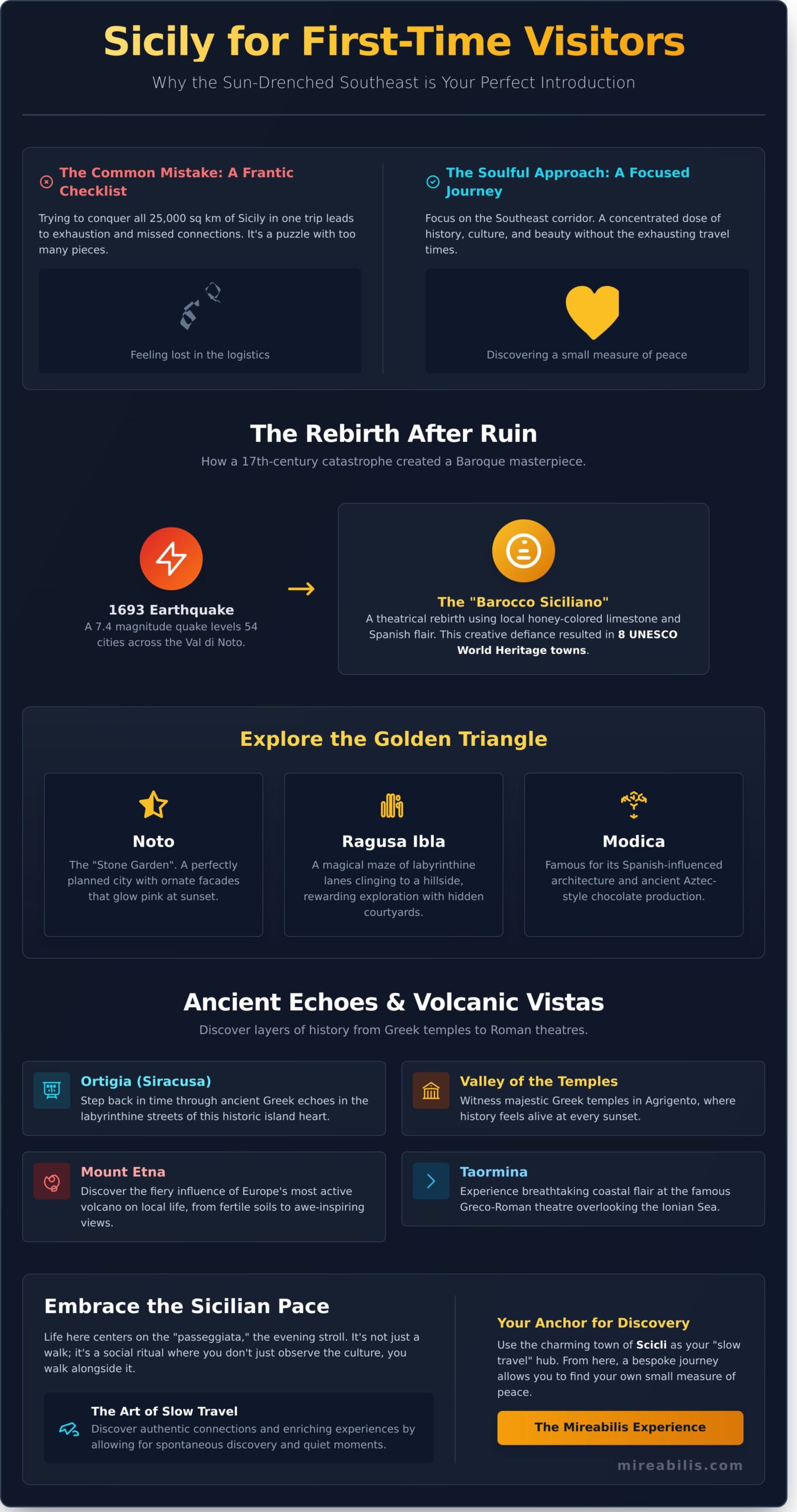
Ancient Echoes and Coastal Flair: From the Temples of Agrigento to the Streets of Ortigia
The history of Sicily isn’t found in dusty textbooks; it’s carved into the very limestone of the southeast. For those exploring sicily for first-time visitors, the landscape offers a profound dialogue between the ancient world and a vibrant, salt-kissed present. This journey moves from the Greek grandeur of Siracusa to the Roman opulence of Piazza Armerina, always returning to the warmth of the Mediterranean coast. While the Greek ruins tell one story, the nearby UNESCO World Heritage Site towns of the Val di Noto showcase a different, baroque soul that we invite you to explore through our bespoke journeys. Our goal is to provide a small measure of peace as you walk through these living monuments.
Siracusa and the Legend of Arethusa
Cicero once described Siracusa as the greatest Greek city and the most beautiful of them all. Founded by Corinthians in 734 BC, the city’s heart remains the island of Ortigia. Here, the Fountain of Arethusa flows with fresh water just inches from the sea, a geological miracle tied to the myth of a nymph fleeing a river god. The Neapolis Archaeological Park showcases the city’s former power with its 5th-century BC Greek Theatre, which could once seat 15,000 spectators. You can still feel the acoustic magic inside the Ear of Dionysius, a 65-meter long cave named by the painter Caravaggio in 1608. For a deeper, more personal connection to the past, the Giudecca district contains ritual baths discovered in 1989 that date back to the 6th century, representing some of the oldest Miqwa’ot in Europe.
Agrigento: A Journey to the Cradle of Democracy
Walking through the Valley of the Temples at sunset is an experience that defies simple description. The Archaeological Park of Agrigento spans 1,300 hectares, making it the largest in the world. The Temple of Concordia, built in 430 BC, remains one of the best-preserved Greek structures on the planet because it was repurposed as a Christian basilica in 597 AD. The people of Akragas sought beauty in every stone, a tradition that continues today during the Almond Blossom Festival. This celebration began in 1934 to honor the arrival of spring and remains a symbol of peace and cultural fusion. We believe these ancient sites are best enjoyed without the pressure of crowds, allowing for a tailor-made experience that connects you to the cradle of democracy.
The Mosaics of Piazza Armerina
Deep in the Sicilian interior lies the Villa Romana del Casale, a 4th-century luxury estate that redefines our understanding of Roman life. The site contains 3,500 square meters of mosaics that were buried by a landslide in the 12th century and remained hidden until systematic excavations began in 1950. These are not just decorations; they are vivid snapshots of daily life. The famous “Bikini Girls” mosaic depicts women participating in weightlifting and ball games, challenging modern assumptions about ancient gender roles. Beyond the art, the villa is an engineering marvel. The sophisticated hypocaust system provided underfloor heating to 50 rooms, a level of comfort that mirrors the refined, relaxed atmosphere we strive to provide for every guest.
To conclude your day, a visit to the coastal village of Marzamemi offers a perfect transition from history to relaxation. This historic tuna-fishing village centers around a Tonnara built in 1752 by the Prince of Villadorata. The old fisherman’s houses now host exceptional restaurants where the soul of Sicily is served in every dish. It’s an essential stop for sicily for first-time visitors who want to feel the authentic pulse of the island. Whether you are dining on fresh bluefin tuna or sipping wine in the central piazza, the atmosphere is one of exclusive adventure and quiet joy.
Fire and Festivity: Experiencing Mount Etna and the Vibrant Traditions of East Sicily
Mount Etna dominates the horizon at 3,357 meters high. It’s Europe’s tallest active volcano and a constant presence in the lives of those living on the eastern coast. When planning a trip to sicily for first-time visitors, understanding the relationship between the people and “A Muntagna” is essential. The volcano isn’t feared; it’s revered as a source of life and fertility. Its eruptions provide minerals that make the surrounding earth 300% more fertile than standard soil, creating a lush landscape that defies the charred appearance of its peaks.
Ascending Mount Etna: A Multi-Sensory Adventure
Walking the Silvestri Craters feels like stepping onto the moon. These vents opened during the major eruption of 1892, leaving behind a stark landscape of black basalt and red iron oxide. The air here is crisp, even in the height of August. Did you know that locals consider Etna a “friendly” volcano? Her lava flows typically move slowly, allowing time for spiritual and physical preparation. This volcanic soil is the secret behind Etna DOC wines. The Nerello Mascalese grapes grown at 1,000 meters altitude produce elegant, mineral-heavy reds that are unique to this specific terroir.
Taormina: Glamour and Antiquity
Taormina sits 200 meters above the Ionian Sea, perched on the side of Monte Tauro. The Teatro Antico, built by the Greeks in the 3rd century BC and later expanded by the Romans, is the town’s crown jewel. The architects designed the stage so the backdrop aligns perfectly with Etna’s smoking summit. It’s a breathtaking fusion of human art and natural power. You can walk the Corso Umberto, the main artery since the Middle Ages, which runs between the Porta Messina and Porta Catania gates. Just below the cliffs lies Isola Bella. Lady Florence Trevelyan bought this tiny island in 1890 and planted exotic flora that still thrives in the Mediterranean warmth today.
Catania and the Feast of Saint Agatha
Catania is a city of resilient spirit, rebuilt after the devastating earthquake of 1693 using black lava stone and white limestone. The centerpiece of the Piazza del Duomo is the Elephant Fountain, carved by Giovanni Battista Vaccarini in 1736. Every February 3 to 5, the city hosts the Feast of Saint Agatha. This is one of the largest religious processions in the world, drawing over 1,000,000 devotees. The spiritual intensity is palpable as massive gilded towers called “candelore” are carried through the streets. For a different sensory experience, visit La Pescheria. This fish market has operated behind the cathedral for centuries. It’s a loud, authentic theater of daily life where the fresh catch is sold before 11:00 AM each morning.
Exploring these historic sites is a journey through the soul of the island. We believe that sicily for first-time visitors should be an intimate experience, free from the rush of standard tourist paths. Book your bespoke Sicilian adventure with us for a tailor-made journey that connects you deeply with the land and its people.
- 08:00: Depart from the peaceful Mireabilis estate in Scicli toward Mount Etna.
- 10:30: Explore the Silvestri Craters and enjoy a private tasting at a high-altitude vineyard.
- 13:30: Arrive in Taormina for a lunch of fresh seafood overlooking the Ionian coast.
- 15:00: Visit the Teatro Antico and enjoy a slow stroll through the botanical gardens.
- 17:30: Stop in Catania to see the Elephant Fountain and witness the evening “passeggiata.”
- 20:00: Return to Scicli for a relaxed dinner under the stars, completing your loop of the east.
The Mireabilis Experience: A Bespoke Journey Starting and Ending in Scicli
Scicli isn’t just a destination; it’s a sanctuary for those seeking a slower, more intentional pace of life. For anyone planning a trip to sicily for first-time visitors, this UNESCO World Heritage site serves as the ultimate “slow travel” hub. While other towns bustle with frantic energy, Scicli offers a small measure of peace. It’s a place where the golden limestone buildings glow at sunset and the rhythm of daily life follows the chime of church bells. Our philosophy at Mireabilis revolves around this sense of calm. We don’t believe in one-size-fits-all tours. Instead, we craft bespoke group holidays tailored to your soul, ensuring every guest feels like a personal friend rather than a tourist.
Your retreat begins at Villa Mireabilis. Nestled in a stunning natural canyon on the edge of Scicli, this exclusive estate is just five miles from the Mediterranean Sea. It offers a unique fusion of land and sea adventures, acting as a relaxed base for your exploration. We’ve committed to a nearly closed energy circle and eco-friendly practices, allowing you to enjoy luxury without compromising the environment. Here, the landscape is your living room. You can breathe in the scent of wild herbs and listen to the silence of the canyon before heading out to discover the Baroque treasures of the Southeast.
The Magic of Scicli: A Living Film Set
The town’s beauty is so cinematic that it became the primary backdrop for the famous Inspector Montalbano television series. Filming began in 1999, and since then, fans have flocked to see the Town Hall on Via Mormino Penna, which serves as the fictional police station. This street is a masterpiece of late Baroque design. It was meticulously rebuilt after the devastating 1693 earthquake. Walking here feels like stepping back in time, surrounded by palaces decorated with ornate stone carvings and expressive balconies.
A short walk leads to the Cave Churches of Chiafura. These grottoes carved into the rock tell a story of resilience and community. Families lived in these cave dwellings for centuries until a national law in 1958 led to their relocation. Today, they remain a poignant reminder of Scicli’s history. Mireabilis offers a depth of connection that makes sicily for first-time visitors feel like a homecoming rather than a holiday. We guide you through these layers of history, from the high art of the Baroque to the humble origins of the cave dwellers.
The Perfect Day: A Sample Mireabilis Itinerary
Your journey is entirely tailor-made, but a typical day with us highlights the best of the region’s flavors and landscapes. We’ve designed this sample itinerary to show how we blend activity with indulgence:
- 09:00: Depart Scicli for a private e-bike adventure. You’ll glide through the Modica countryside, passing ancient dry-stone walls that have been part of the UNESCO Intangible Heritage list since 2018.
- 13:00: Enjoy a bespoke culinary experience at a family-run vineyard near Noto. You’ll taste Nero d’Avola wine produced from 40-year-old vines, paired with local cheeses and sun-dried tomatoes.
- 16:00: Board a private vessel for a sailing excursion along the Sampieri coast. You’ll watch the sun dip below the horizon behind the Fornace Penna, an industrial ruin dating back to 1912 that sits majestically on the shoreline.
- 20:00: Return to the comfort of Villa Mireabilis. A local chef will prepare a candlelit dinner featuring traditional Ragusan flatbreads and fresh seafood caught that morning.
Our commitment to personal service means no impersonal online bookings or crowded buses. We focus on the details that matter, from the warmth of the Mediterranean sun to the precision of a perfectly planned day. Ready to make Mireabilis your next adventure base? Let’s talk about your journey.
Begin Your Personal Chapter in the Val di Noto
Discovering sicily for first-time visitors means moving beyond guidebooks to find the island’s soul. You’ve explored the 1693 earthquake’s legacy through Noto’s golden stone and tasted 400 year old chocolate traditions in Modica. To capture this magic, we invite you on a signature day tour. Start at 08:30 from the quiet streets of Scicli, arriving at the Valley of the Temples by 10:30 to witness 2,500 years of history. After a traditional lunch, spend your afternoon marveling at 3,500 square meters of mosaics at Villa Romana del Casale before returning to the sanctuary of Scicli by 18:30.
As specialists in Southeast Sicily and the Val di Noto, we offer exclusive access to Villa Mireabilis, our private estate in Scicli. We create tailor-made programs for small, discerning groups who seek a fusion of land and sea adventures without the crowds. It’s about finding that small measure of peace through a bespoke itinerary designed just for you. We’re ready to share our passion and welcome you as a personal friend.
Start planning your bespoke Sicilian adventure with Mireabilis today
The Mediterranean warmth is waiting for you. Let’s create an unforgettable journey together.
Frequently Asked Questions
Is Sicily safe for first-time visitors?
Sicily is exceptionally safe for first-time visitors, particularly in the Southeast where crime rates remain 30% lower than in major European metropolitan hubs. You’ll find that the streets of Scicli and Noto feel like an extended outdoor living room where locals look out for one another. While standard travel precautions apply, the warm, community-focused atmosphere provides a small measure of peace that’s rare in other global destinations.
How many days do I need for a first-time trip to East Sicily?
You should plan for 7 to 10 days to fully experience the wonders of East Sicily without feeling rushed. This timeframe allows for 3 days exploring the Baroque triangle of Ragusa, Modica, and Scicli, plus 2 days for the ancient history of Siracusa and 1 day for the volcanic landscapes of Mount Etna. A 10-day itinerary ensures you have time for a bespoke journey that balances cultural discovery with relaxation at Villa Mireabilis.
What is the best time of year to visit the Val di Noto?
The best time to visit the Val di Noto is during May or September when daily temperatures average a comfortable 22 to 25 degrees Celsius. May is particularly vibrant because the Infiorata di Noto flower festival takes place on the third weekend of the month. Visiting during these shoulder seasons avoids the 35-degree heat of August and ensures you can enjoy the UNESCO sites in a more intimate, quiet setting.
Can I visit Mount Etna and Taormina in one day?
You can visit Mount Etna and Taormina in a single day, as the drive between the two takes about 55 minutes. Start your morning at 8:30 AM on the volcanic slopes to witness the craters before the clouds roll in. By 1:30 PM, you can be sitting in Taormina for lunch overlooking the Ionian Sea. It’s a classic fusion of land and sea that captures the diverse spirit of the island in 10 hours.
What are the must-try foods in Southeast Sicily?
You must try Scaccia in Ragusa, a folded flatbread filled with tomato and cheese that dates back to the 17th century. Don’t leave without tasting the cold-processed chocolate of Modica, which follows an ancient Aztec recipe brought here in the 1500s. For a true taste of the coast, order Pasta alla Norma in Catania, featuring fried eggplant and salted ricotta. Sicily’s soul is in its flavors, and these dishes offer an unforgettable culinary adventure.
Do I need to speak Italian to enjoy the smaller towns like Scicli?
You don’t need to be fluent in Italian to enjoy towns like Scicli, as 65% of younger locals and hospitality professionals speak English. However, learning “Buongiorno” or “Grazie” opens doors to deeper connections with the residents. At Villa Mireabilis, we act as your personal hosts to bridge any gaps, ensuring your bespoke holiday feels like a conversation with friends rather than a series of transactions with strangers.
What should I pack for a bespoke holiday in Sicily?
Pack breathable linen clothing and sturdy walking shoes for navigating the 18th-century cobblestones of the Val di Noto. You’ll want a light jacket for evenings, as temperatures can drop by 8 degrees after sunset in the natural canyons. Include a smart-casual outfit for dinner at upscale restaurants in Siracusa. Since your journey is tailor-made, remember a swimsuit for the Mediterranean and gear for e-biking through the rugged Hyblaean hills.
Why is the Southeast better than the North for a first visit?
The Southeast is ideal for sicily for first-time visitors because it concentrates 8 UNESCO World Heritage sites within a small, accessible radius. Unlike the crowded northern hubs, towns like Scicli offer an authentic, unhurried pace that feels like a personal invitation into Sicilian life. You’ll experience a unique fusion of Greek history and Baroque architecture without the impersonal atmosphere found in larger, more commercialized cities. It’s the perfect introduction to the island’s soul.